
In-depth Analysis of Racing Game Simulators
Speaking of racing motion simulators, they are actually “old equipment” that has appeared for many years, but most people have at most only seen similar things in game arcade, and there may not be many who have actually experienced or understood them.
To introduce the racing motion simulator, we must start by talking about how it moves.
In the three-dimensional space of an object, there are at most 6 “Degrees of Freedom” (6-DOF), namely translation along the X, Y, and Z axes and rotation along the X, Y, and Z axes. By superimposing changes in position, velocity, and acceleration across these 6 degrees of freedom, the simulator can approximately simulate the physical sensations of a person inside a vehicle.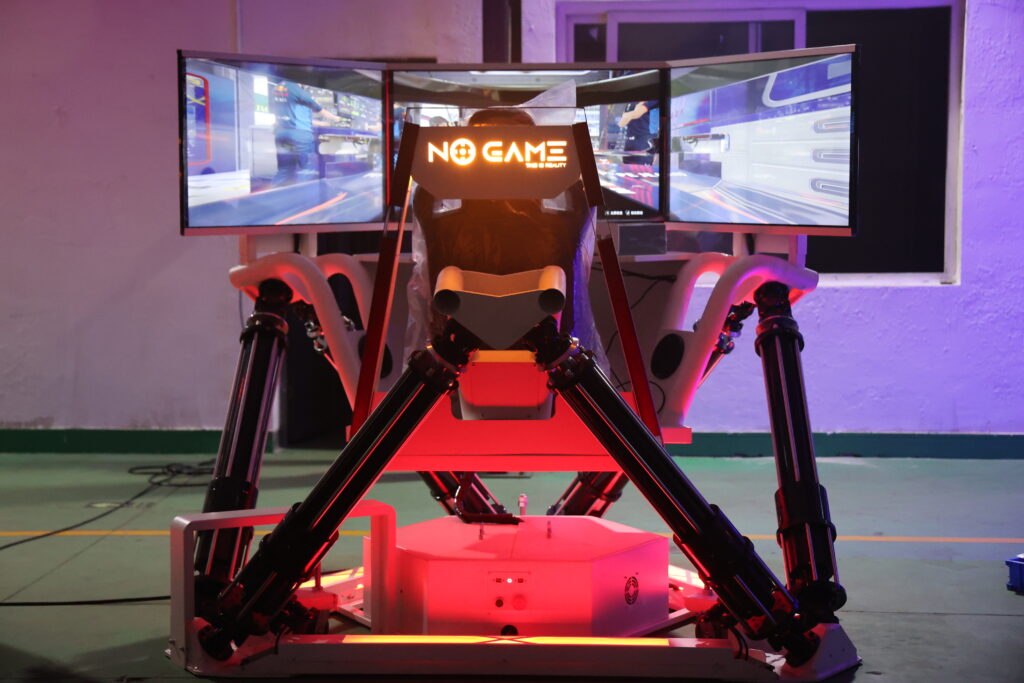
A complete racing simulator is generally composed of a main structure, a computer simulation system, operating peripherals, a display system, and a motion system, etc.
Main Structure: Generally made of structural materials such as steel or aluminum alloy, it plays the role of supporting the cockpit and connecting the motion system.
Computer Simulation System: Can use a PC to install corresponding racing simulation or game software. Common simulation software includes Project CARS, GSC, LFS, WRC, etc.; entertainment games include DiRT, GRID, etc. What? You say Need for Speed? This kind of game with cool visual effects but fake physical simulation obviously cannot get onto a professional racing simulation platform.
Operating Peripherals: Refer to the control panel composed of the steering wheel, pedals, gear lever, handbrake, etc. Brands providing such equipment include Logitech, Thrustmaster, Fanatec, and so on.
Display System: Common types include multi-screen splicing of LCD monitors, curved screen projection, etc., and of course, VR glasses. Since the appearance of VR, the exploration of interaction methods in virtual environments has never stopped. Whether it is Oculus’s Touch controller, the KAT motion platform, or Noitom’s motion capture technology… they all aim to continuously expand the territory of the VR experience, attempting to put people into a virtual world as “free” as the real world. While those like Richer Tech, who do virtual racing experiences, focus on a specific virtual scenario, building the experience in this scenario to be infinitely close to reality. Any technology or equipment helpful for improving this experience receives their attention, such as VR. The significance of the maturity of VR technology is epoch-making, so we attach great importance to VR itself; whether they are tech giants or startups, they all focus on building a peripheral content ecosystem and interaction methods for this “newborn” technology. However, the refresh rate of current mainstream VR glasses is still insufficient, while racing games have very high requirements for the refresh rate.
Motion System:Finally, it is necessary to emphasize the “Motion System,” which is the part that actually makes the whole equipment move, and move well and realistically. This system generally contains motion control software, motor drivers, and electric cylinders/reduction transmission mechanisms.
After the motion control software obtains data such as vehicle attitude and acceleration from the computer simulation system in real-time, it parses it into motion data suitable for the simulator’s structure, then sends it to the motor driver. The motor driver drives the motor to make corresponding actions, thereby transmitting real physical feedback. What affects the degree of simulation realism is the parsing algorithm on the software side, and the motors that push the entire equipment on the hardware side.
Common motors generally include induction motors, stepper motors, and high/low voltage servo motors, etc. Among them, servo motors have the most excellent performance, with sensitive acceleration and deceleration, and the highest rotational speed can even reach 6,000 rpm, being able to withstand 300% overload in a short time. They are widely applied in industrial robots and CNC machine tools. As mentioned before, if a simulator wants to realize 6-DOF motion simulation, it generally needs at least 6 electric cylinders (but due to the high price of servo electric cylinders, 4-DOF, 3-DOF, and 2-DOF racing simulators have appeared). Every change in a degree of freedom requires 6 electric cylinders to make changes simultaneously to be completed. The control software decomposes the overall motion data into independent actions for each motor through an inverse solution algorithm. This is a very complex process, and the most complex part is how to better reflect acceleration—an important parameter affecting the racing experience—on the platform. This is also the direction of the current Richer Tech engineering team’s efforts.
The process of servo electric cylinders in racing game simulators achieving precise simulation of vehicle movement involves the following key technical links:
Sensor Feedback: Servo electric cylinders are usually equipped with position, speed, and force sensors, which can monitor and feedback the motion state of the cylinder body in real-time. This data is crucial for ensuring the accuracy of the simulation.
High-Precision Control: By using advanced control algorithms, servo electric cylinders can accurately control the position, speed, and acceleration of the motion platform. This ensures that the response simulated by the racing simulator matches the dynamic characteristics of a real racing car.
Mechanical Modeling: The racing simulator’s software establishes a vehicle dynamics model according to physical principles. This model considers factors such as mass distribution, suspension system, and tire grip to predict the vehicle’s behavior under different conditions.
Real-time Calculation and Processing: High-performance computer hardware is used to process data from sensors in real-time and perform rapid calculations according to the mechanical model to control the actions of the servo electric cylinders. This ensures the real-time nature of the racing simulator simulation and the sensitivity of the response.
Force Feedback: Servo electric cylinders do not just simply move the platform; they can also simulate force feedback under different road conditions. For example, when simulating a slippery road, the servo electric cylinder can increase steering resistance to simulate the feeling of tires slipping.
Adaptive Adjustment: Modern racing simulators allow users to adjust the difficulty and realism of the simulation according to their own preferences and skill levels. This means the servo electric cylinders can adjust the strictness of the simulation according to the user’s settings.
User Input: The driver’s operations (such as turning the steering wheel, stepping on the brake or accelerator pedal) are converted into corresponding electrical signals through the simulation system, and these signals are used to control the servo electric cylinders, thereby driving the motion platform of the racing simulator.
- Integration of Software and Hardware: All these technologies must be seamlessly integrated to ensure the continuity and realism of the simulation. The software must be able to accurately interpret the hardware’s feedback, and the hardware must be able to accurately execute the software’s instructions.

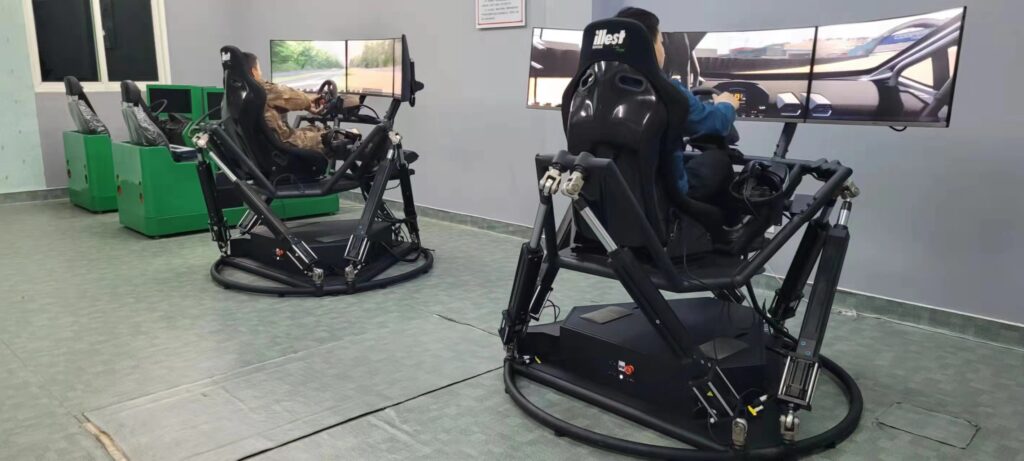
What Are The Best Racing Game Simulator Manufacturers Selection?
Racing simulators range from low-end to high-end, with prices ranging from a few handred dollar to over tens of thousands dollar, including foreign brands and domestic brands.
Cruden from the Netherlands is a top-tier brand in racing simulators, with each machine priced at about 1 million RMB. It is said that many F1 drivers use this simulator to familiarize themselves with tracks, record operation data, and improve performance through data analysis.
Force Dynamics from the United States is the second-ranked brand after Cruden. The electric cylinders of Force Dynamics simulators are very long and can simulate relatively large tilt angles and undulations, which can better restore the “push-back” sensation. However, the motion delicateness of Force Dynamics is average; additionally, because it adopts synchronous belt transmission, responsiveness and rigidity are compromised.
Additionally, it is necessary to mention D-BOX from Canada. This company is a subsidiary of a Canadian military enterprise, specializing in motion sofas for movies, motion seats for theaters, and dynamic simulators. Their products target the home personal consumer level, and the disadvantage is that the motion stroke is relatively short.
And China’s leading enterprise in racing simulators—Richer Tech. Its dynamic simulator products adopt high-power motors and self-developed motion control cards. Its racing simulator motion platform has a very high vibration frequency and response speed, and can easily simulate delicate motion sensations like different road hardness, driving through water, or pressing over curbs. The reaction has almost no delay, and the simulation experience at the game level is already very shocking. More importantly, relying on China’s powerful supply chain system, while improving mechanical motion quality, Richer Tech also provides rich configuration choices. More importantly, compared to European and American suppliers, the price of Richer Tech racing simulators has a very big advantage, with the average price being nearly half less. Even considering ocean transportation costs, tariffs, etc., the overall price is still lower!
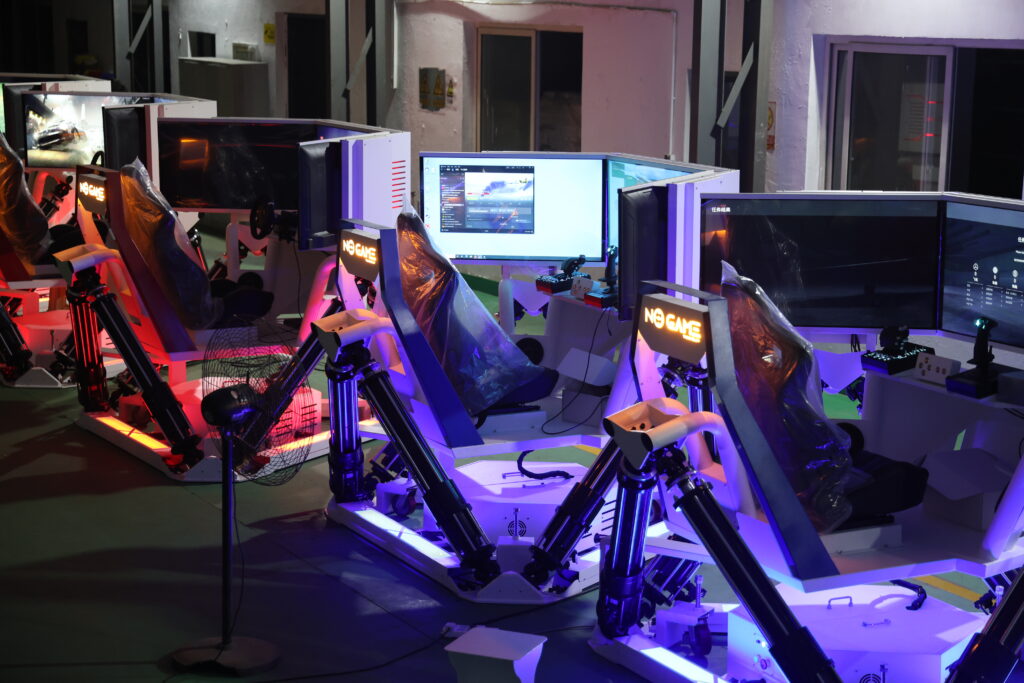
driving game machine