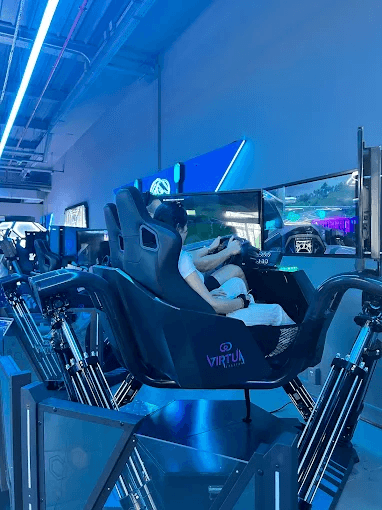
Every individual who pursues speed and passion shares a dream of the racetrack; however, this sport demands significant time and financial investment and carries high risks, making it inaccessible to many. Fortunately, technology changes lives. The existence of racing simulators allows us to enjoy an intense driving experience as realistically as possible without incurring massive costs. By restoring authentic characteristics both physically and visually, racing simulators have become the top choice for many racing enthusiasts.
How the 6 DOF racing simulator works?
To put it simply, an object in 3D space has a maximum of six degrees of freedom (translation and rotation along the X, Y, and Z axes); therefore, a dynamic simulator also has a maximum of six degrees of freedom, known as “6-DOF“. They can simulate a machine’s movement in forward/backward, left/right, and up/down directions. By overlaying and varying the three parameters of position, velocity, and acceleration across these six degrees of freedom, the system can closely approximate real human physical sensations. To achieve 6-DOF, at least six servo electric cylinders are typically required. Hydraulic cylinders are generally avoided because hydraulic proportional valves have poor control performance; their responsiveness and precision cannot match servo electric cylinders, making them unable to meet the demands of a racing simulator’s intense movements.
A racing simulator provides an unprecedented sense of realism.
It is not only equipped with professional steering wheels, throttles, brakes, and clutch systems, but also allows you to choose the corresponding steering wheel and shifting method based on different racing events. Especially when operating sequential shifters and handbrakes—combined with high-definition screens and professional racing seats—it absolutely gives you the urge to drift.